

Summary and scope.
What this article covers.
This is a reference article in the strict sense. It is written for collectors of Baltic amber, for auction-house researchers preparing catalogue notes, for museum curators reviewing acquisitions, for academic readers working on the material culture of inter-war East Prussia, and for the descendants of German emigrants who have inherited unattributed amber pieces and who need a place to begin. It tries to be the document that, when consulted in passing, settles a question for good, the date a workshop opened, the spelling of a designer's name, the wording on a clasp, the destination of a 1937 exposition prize. Where a question cannot be settled, it says so plainly.
The article covers the institutional history of the State Amber Manufactory from its prehistory in the Stantien & Becker concession of 1858 to its final dissolution in the spring of 1945, with subsequent chapters on the dispersal of stock, the survival of the design tradition through Alfred Schlegge and others, the Soviet continuation of amber extraction at Palmnicken, and the position of SBM pieces on the present-day collector market. It treats the principal designers, Hermann Brachert, Jan Holschuh, Toni Koy, at a length proportionate to their documented influence, and points the reader toward a dedicated companion essay where finer distinctions of attribution are pursued.
What it does not cover.
It does not cover non-Baltic amber. Dominican, Burmese, Mexican and Sumatran amber are excluded from the scope of the bernsteinmobil network as a matter of editorial principle, and there is no comparable institutional history attached to those materials in any case. It does not cover the Amber Room (Bernsteinzimmer) of Tsarskoye Selo except where its loss in 1945 forms part of the same narrative arc as the SBM's destruction; for that subject the Smithsonian Magazine's standing essay remains the best brief introduction in English. It does not provide a price list. Indicative price corridors are quoted where they help readers calibrate expectations, but no piece is appraised in absentia, and no specific auction price is invented or extrapolated.
Note on sources.
The academic-grade references for the material itself are Beck, C. W. (1986), "Spectroscopic Investigations of Amber," Applied Spectroscopy Reviews 22:57–110, and Weitschat, W. & Wichard, W. (2002), Atlas of Plants and Animals in Baltic Amber (Pfeil, Munich), the standard English-language reference for inclusions and palaeobiology of Baltic succinite. The single most important secondary source on the SBM itself is the monograph by Ulf Erichson and Leonhard Tomczyk, Staatliche Bernstein-Manufaktur Königsberg 1926–1945 (ISBN 3-00-002986-9), published privately in 2002, which worked from surviving company papers, contemporary photographs and the holdings of the Kaliningrad Amber Museum to produce what remains the closest thing to a definitive German-language account. For institutional context the published material of the Kaliningrad Amber Museum (Музей янтаря) is indispensable, in particular its dedicated section on the Königsberg Manufactory. For general reference, encyclopaedic context for the principal designers is taken from the English Wikipedia entries on Jan Holschuh and Hermann Brachert and, for Toni Koy, from the German entry, since no English article exists at the time of writing; gemmological data on Baltic succinite is cross-checked against the entries on amber in Wikipedia, Encyclopaedia Britannica and the International Gem Society's gem encyclopedia. Where a specific claim depends on a single source it is cited by name in the running text; where a specific auction record is mentioned it is cited by house, lot and date.

Origins: from Stantien & Becker to a state monopoly.
The Palmnicken concession.
Industrial amber extraction on the Samland peninsula begins not in 1926 but a full century earlier. The seam of glauconitic clay known to East Prussian geologists as the Blue Earth (Blaue Erde), a marine deposit of the middle Eocene, roughly thirty-four to forty-eight million years old, outcrops along the Samland coast between Brüsterort and Palmnicken at a depth at which open-pit mining becomes economical. From the medieval period until the early nineteenth century, the Prussian crown asserted a monopoly on amber gathered along the shoreline and reserved the punishment of unauthorised collection (the so-called Strandregal) to its own courts. With the dissolution of the monopoly in 1811 and the gradual industrialisation of the Samland coast, the systematic exploitation of the Blue Earth became technically possible for the first time.
The decisive event of the nineteenth century was the granting of a concession at Palmnicken, the small village on the western Samland shore that since 1947 has borne the Russian name Yantarny. The first industrial extraction at Palmnicken began in 1827; serious open-pit operations on a scale that transformed the world supply of amber commenced under the Memel firm Stantien & Becker in 1858 (Wikipedia, "Yantarny, Kaliningrad Oblast"; accessed 2026).
Stantien & Becker (1858–1899).
Friedrich Wilhelm Stantien (the dredging contractor from Memel) and his Königsberg partner Moritz Becker built the Palmnicken operation into the world's first open-pit amber mine. By the late 1880s the firm controlled both the dredging of amber from the Curonian Lagoon at Schwarzort and the mining of amber at Palmnicken, and held a near-monopoly over the European wholesale supply. Stantien & Becker also operated cutting and grading workshops at Königsberg, employed hundreds of workers, and shipped material to the cutters of Vienna and Idar-Oberstein. Their dominance was, in retrospect, the precondition for the state takeover that followed: by the end of the century they had demonstrated that amber could be mined at industrial volume, but the firm's exit from the business in 1899 left a vacuum that only a state-backed enterprise was equipped to fill.
Königliche Bernstein-Werke and Preussag.
In 1899 the Prussian state acquired the Stantien & Becker concession and established the Königliche Bernstein-Werke (Royal Amber Works) as a state enterprise. The Königliche Bernstein-Werke ran the mine at Palmnicken and the central refining and cutting workshops at Königsberg through the First World War and into the 1920s, surviving the abolition of the monarchy in 1918 and the formal renaming that followed. After the war the enterprise was rolled into the Preussische Bergwerks- und Hütten-Aktiengesellschaft, Preussag, the state-owned Prussian mining and metallurgical conglomerate which from the early 1920s consolidated the residual industrial assets of the former Crown into a single joint-stock vehicle. Preussag's involvement is the legal and financial precondition for what happened in 1926.
Foundation of the SBM in 1926.
In 1926 a deliberate institutional decision combined the extractive operation at Palmnicken with the design and production workshops at Königsberg into a single enterprise under the name Staatliche Bernstein-Manufaktur. The new manufactory was constituted as a joint-stock company with the parent Preussag at its head, and with subsidiary branches at Berlin and Danzig (Kaliningrad Amber Museum, "History of the Königsberg State Amber Manufactory"). The political logic was straightforward: the Prussian state had concluded that the export value of finished amber was many times the export value of raw amber, that the Stantien & Becker workshops had never been adequately industrialised, and that the prestige of German design in the inter-war period would be best served by a vertically integrated enterprise capable of presenting Baltic amber at world expositions as something more than a raw commodity. The 1926 foundation, accordingly, is not merely an administrative reorganisation. It is a strategic decision to elevate amber, by means of a single integrated workshop, to the level of fine jewellery and applied art.
From 1926 onwards the SBM held, in practice, a monopoly on the supply of Baltic amber to the German market. Independent goldsmiths working in amber, Toni Koy in Königsberg, Walter Kramer on the Fischland coast, the silversmiths of Bückeburg, sourced their raw material from the SBM and worked at its margins. Within ten years the manufactory employed by some estimates some 2,650 people across mine and workshops, maintained representative offices in Paris, London, Vienna, Brussels and New York, and was supplying fittings to the royal courts of northern Europe and ceremonial objects to the Reich administration in Berlin (Kaliningrad Amber Museum).

Location and architecture in Königsberg.

Lindenstraße / Wrangelstraße site.
The SBM occupied a corner site at the meeting of Lindenstraße and Wrangelstraße, in the inner Hufen district of Königsberg, several minutes' walk west of the cathedral. The block had originally been built before the First World War as part of the city's expansion into the western suburbs and was occupied by the Königliche Bernstein-Werke from the early 1900s; the SBM inherited the premises in 1926 and remained there until the building was destroyed in the August 1944 air raids. The site, like most of inner Königsberg, has not been rebuilt; the corner today is an empty lot in the Russian city of Kaliningrad.
The Italian Neo-Renaissance facade.
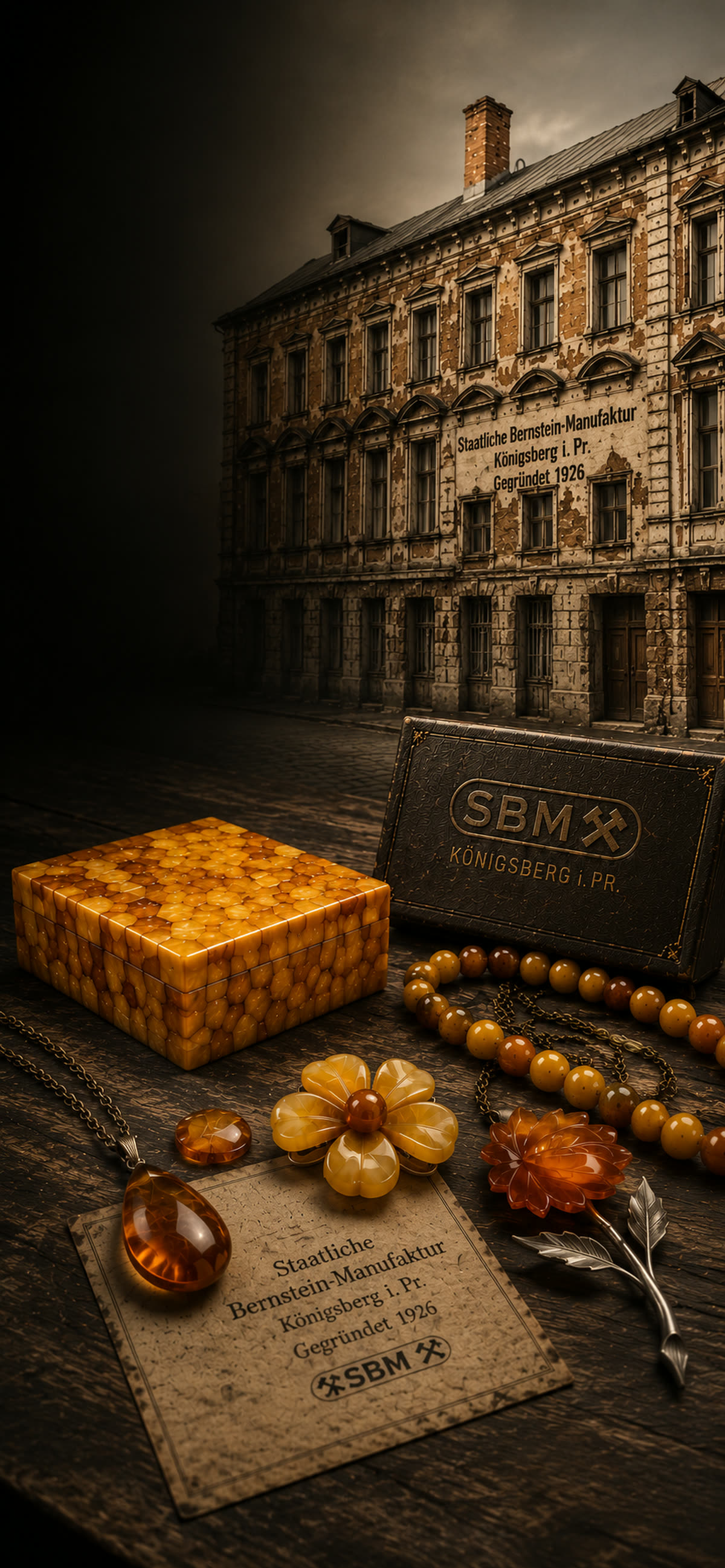
Period photographs show a three-storey corner building in the Italian Neo-Renaissance manner, with rusticated ground-floor masonry, a piano nobile of arched windows divided by pilasters, and an attic story crowned by a low cornice. The architectural vocabulary is conventional for the late Wilhelmine period and would be unremarkable if the building did not happen to have housed what was, by the 1930s, the most internationally visible amber enterprise in Europe. A bronze relief over the principal entrance carried the cypher of the manufactory and the legend STAATLICHE BERNSTEIN-MANUFAKTUR; this relief, like the building, is lost.
Workshops, gallery and directorate.
The internal disposition of the building, reconstructible from Erichson and Tomczyk's archival photographs, placed the production workshops on the ground floor (with separate rooms for grinding, drilling, polishing, silver-mounting and final assembly), a public showroom and gallery at street level facing Lindenstraße, the directorate and design office on the piano nobile, and storage of finished work and raw stock in the attic and basement. The 1934 reorganisation under Holschuh's artistic direction added a dedicated sculptural studio at the rear of the courtyard, where larger sculptural pieces in amber, ivory and mammoth ivory were carved. Direct contact with the Palmnicken mine was by rail and road; raw amber arrived at Königsberg in sorted batches that had already undergone initial cleaning and grading at the mine.
Beyond the Königsberg premises themselves, the SBM operated representative offices in five other European and trans-Atlantic capitals, Paris, London, Vienna, Brussels and New York, through which the export trade was channelled (Kaliningrad Amber Museum). These were not full subsidiaries but commercial agencies, holding sample collections and taking orders for direct delivery from Königsberg; their existence is the institutional reason why SBM pieces appear today in private collections in Britain, France, Belgium, the Low Countries, Austria and the eastern United States.

Material: Baltic succinite from Palmnicken.
The blue earth horizon.
The material worked at the SBM was, almost without exception, Baltic succinite, the chemically and mineralogically distinct fossil resin that constitutes the great majority of European amber and the source of the technical term succinite, after the Latin succinum. Succinite is distinguished from other fossil resins by a characteristic infrared absorption spectrum (the so-called Baltic shoulder in the carbonyl region around 1250 wavenumbers), by a succinic-acid yield of between three and eight per cent on dry distillation (with the highest values in pale, opaque and bony varieties), by a Mohs hardness of two to two-and-a-half, and by a specific gravity in the narrow range of 1.05 to 1.10 grams per cubic centimetre (Wikipedia, "Amber"; Britannica, "Amber"; International Gem Society, "Amber").
Geochemically, succinite is now most often referred, on the basis of FT-IR comparison with modern relict resins, to a conifer assemblage in or near the family Sciadopityaceae, today restricted to a single relict species in Japan but, in the middle Eocene, likely a more widespread element of the boreal forests of what is now northern Europe. The older literature, following Conwentz (1890), treats the source as a single hypothetical species Pinus succinifera; modern palaeobotany has moved away from that attribution. The Blue Earth horizon at Palmnicken is the marine reworking of those forest deposits: a glauconitic clay laid down in the Eocene shallow sea that covered what is now the southern Baltic basin, into which amber nodules were transported and redeposited from upstream estuarine environments. The horizon is consistent in lithology and in amber yield over a coastal strip several kilometres long. By weight, approximately ninety per cent of the world's commercially extractable amber lies in this single Baltic deposit.
Extraction at Palmnicken (Yantarny).
The Palmnicken mine was, and remains, the principal source of Baltic amber. By 1937, the apex year of pre-war operations, annual production reached 650 tonnes of raw amber, worked by approximately 700 miners and processing staff (Wikipedia, "Yantarny"). Extraction was by open-pit method, with the overburden stripped by steam shovel and the Blue Earth horizon washed through a series of graded screens to separate amber from the clay matrix. The largest nodules, those of fist size and above, were set aside for use in sculptural and ceremonial pieces; smaller pieces went to the jewellery line; the very smallest fractions, together with the cutting waste, were diverted to industrial uses, most notably the distillation of succinic acid and the manufacture of varnish.
From raw nodules to manufactory stock.
Raw amber arrived at the Königsberg workshops after initial sorting and washing at Palmnicken. A first triage divided the stock into clear material (suitable for cabochons, beads and inclusions display), opaque material (suitable for sculptural pieces, mounts and Trachten-style necklaces in which colour rather than transparency is the point), and material with visible inclusions, which was reserved for special commissions and the export trade where authenticated insect-bearing pieces commanded premium prices. A second triage by colour distinguished the standard honey, butter, marbled white and bony grades that recur throughout the SBM jewellery vocabulary. A third triage by size determined the destination: workshop A for olive beads and small mounts, workshop B for cabochons and brooches, workshop C for larger sculptural work.
Colour and clarity grading inside SBM.
The internal grading nomenclature of the manufactory recognised approximately a dozen named grades, of which the following are most often seen in surviving inventory cards: klar honig (clear honey), klar cognac (clear cognac), halbklar (semi-clear), butter, weiss-marmoriert (marbled white), knochen (bony, opaque pale), flohmig (foamy, with fine bubbles), and gewolkt (clouded). The grading was practical rather than systematic: a single olive necklace might combine three or four named grades to achieve a continuous tonal gradient across the strand, and the most prized pre-war olive necklaces are precisely those in which the colour graduation has been managed with deliberation. This internal vocabulary is the direct ancestor of the grading language still used by Baltic amber dealers today, and is the reason that the German technical terms remain in use among collectors and curators even in English-language catalogues.

The designers.

Hermann Brachert (1890–1972).
The sculptor Hermann Brachert is the single name most closely associated with the design language of the SBM in the public mind, although he never held the formal title of artistic director. Brachert (born Stuttgart 1890, died Stuttgart 1972) was invited in 1919 to a chair at the Königsberg School of Arts and Crafts (Kunstgewerbeschule), where he taught sculpture, interior design and jewellery (Wikipedia, "Hermann Brachert"). From the late 1920s onwards he was art consultant to the SBM, and during the decisive expansion of the early 1930s, the period in which the manufactory's reputation was made, his name appears on the most important sculptural commissions. In 1933 the SBM exhibited at the Chicago World's Fair a large amber cross and a pair of altar candlesticks designed by Brachert (Kaliningrad Amber Museum, "Amber Manufactory"). In the same year Brachert was stripped of his teaching and professional rights under the new political dispensation in Germany, a measure taken in response to his open opposition to the cultural ideology of the regime; he remained, however, under contract to the SBM as consultant, and continued to design for the manufactory until 1944.
Brachert's documented amber output runs to roughly seventy works, alongside more than a hundred sculptures in bronze and marble (Kaliningrad Amber Museum). His amber pieces are characterised by an austere, modernist treatment of figure and form, slender female nudes, animal heads simplified almost to schematic shorthand, geometrical reliefs, that stands at the head of the Baltic amber Art Deco. The Brachert house at Georgienswalde (today Otradnoye) on the Samland coast, where he kept his summer studio, has been a memorial museum since 1991 and holds the largest single concentration of his amber work outside the Kaliningrad Amber Museum.

Jan Holschuh (1909–2000).
If Brachert is the consulting artist, Jan Holschuh is the artistic director in the institutional sense. Born 9 August 1909 in Erbach im Odenwald, the small Hessian town whose carving tradition in ivory had been continuous since the eighteenth century, Holschuh trained as an ivory carver in his home town before continuing his studies in Königsberg in the early 1930s (Wikipedia, "Jan Holschuh"). From 1934, on the dating accepted by Wikipedia, he was art director of the SBM (the Kaliningrad Amber Museum dates his elevation to artistic head as 1933, a one-year discrepancy that has not been finally resolved in the literature). He remained in that position until his return to Erbach at the end of the war.
Holschuh's lifetime output of over two hundred sculptures in ivory, mammoth ivory and amber is divided between his SBM years and his post-war activity in Erbach. He had received the Grand Prix at the 1929 Barcelona International Exposition as a young carver, and the State Prize of Munich (Bayerischer Staatspreis) in 1966; the Erbach phase of his work is well documented in the German specialist literature on ivory carving. Within the SBM, Holschuh's responsibility was the integration of the sculptural programme with the broader product line: it is under his direction that the manufactory's representational pieces, figures of animals, of allegorical subjects, of historical scenes, acquire the formal coherence that distinguishes them from the more pedestrian amber sculpture of the late nineteenth century. Holschuh died on 2 August 2000.
Toni Koy (1896–1989): independent goldsmith in the SBM orbit.
Toni Koy is the third name that any serious account of pre-war Königsberg amber must treat at length, and the only one of the three whose relationship to the SBM was that of an independent collaborator rather than an employee or contracted consultant. Koy was born in 1896 at Wormditt in Ermland (today Orneta in Poland's Warmian-Masurian Voivodeship) and opened her own goldsmith's workshop in Königsberg in 1921, specialising in artistic amber work in combination with precious metals (Wikipedia, "Toni Koy", German entry; no English article exists at the time of writing).
Koy's most celebrated piece is a chain of gold and amber executed for the 1937 Paris Exposition Internationale, for which she received a high-level award in the goldsmith and silversmith category. The precise designation of that award is, however, less certain than is sometimes claimed. Some German sources record it as the Grand Prix; others, including the citation given in the Erichson and Tomczyk monograph, give it as the Gold Medal; a primary catalogue entry of the kind that would settle the question has not been located in the public literature. The most defensible statement is that Koy received a high-level award (Grand Prix or Gold Medal) in the goldsmith category at the 1937 exposition. The piece itself does not survive; it is known only from photographs.
Koy's working relationship with the SBM was that of a privileged independent supplier: she sourced raw amber from the manufactory, executed her own designs in her own workshop, and exhibited and sold her work both under her own name and through the SBM's representative offices abroad. She collaborated on specific projects with both Brachert and Holschuh, the boundary between Koy mounts and SBM-workshop mounts is, on smaller pieces, a matter of expert judgement and not always resolvable from a clasp alone. After her flight from East Prussia in 1945 Koy re-established her workshop at Annaberg-Buchholz in the Saxon Erzgebirge, where she continued to work until her retirement in 1975 and her death in 1989.
Other hands.
Beyond Brachert, Holschuh and Koy, a number of other designers and craftsmen worked at the SBM whose names have survived only in fragmentary form. The Erichson and Tomczyk monograph lists individual silversmiths, lapidaries and apprentices whose initials appear on surviving pieces but whose full identification has not been recovered. Among the documented apprentices the case of Alfred Schlegge (1923–2015), born in Königsberg and the last SBM-trained amber carver known to have survived to the West, is treated in a later section. The Königsberg School of Arts and Crafts continued to supply trained personnel to the manufactory through the 1930s, and a number of graduates of that school who briefly held positions at the SBM later resurfaced in the West-German amber and ivory trades after 1948, though here the documentary trail thins out, and individual attributions must be made with caution.
Product groups.

The Kaliningrad Amber Museum, working from internal SBM documents, distinguishes five product groups into which the manufactory's output was systematically divided. The following inventory follows that institutional classification, with the German period vocabulary preserved in parentheses where it is still used by the trade.
Jewellery (olive necklaces, cabochon brooches, Trachten necklaces, pendants).
Jewellery was the volume product of the SBM and the basis of the manufactory's economic viability. Within the jewellery group, four sub-types account for the great majority of surviving pieces. The graduated olive-bead necklace (German: Olivenkette) is the most numerous: a strand of typically thirty to fifty barrel-shaped beads, hand-shaped and hand-drilled, in which the bead size graduates from a maximum of approximately fifteen millimetres at the centre to a minimum of approximately five millimetres at the clasp. The grading of bead colour across the strand is the principal aesthetic decision and the principal index of workshop quality.
The cabochon brooch (Cabochon-Brosche) is the second-largest sub-type. A single domed amber cabochon, typically twenty to thirty-five millimetres in diameter, is set in a silver mount (most often 835 fineness, occasionally 800 or 935) with a hand-soldered pin reverse. Brachert's brooch designs of the early 1930s established a vocabulary of geometrical mounts, chevron, fan, radiating bar, that became almost a signature of the SBM and was widely imitated by independent goldsmiths after the war.
The Trachten necklace (Trachtenkette), that is, the regional folk-costume necklace, is a more elaborate construction in which one or several large cabochon centrepieces are flanked by smaller beads, often with intermediate silver elements and sometimes with pendant elements hanging from the centre. The SBM Trachtenketten of the late 1930s draw on Bückeburg, Schaumburg-Lippe and East Prussian regional traditions and are among the most actively collected categories in the present market. They are not to be confused with the older Bückeburger Trachtkette in the strict sense, which is an independent local tradition centred on the small town of Bückeburg in Lower Saxony and treated in our German-language reference at /bernstein-bueckeburger-trachtkette.
Pendants and earring sets make up the remainder of the jewellery group. They tend to repeat the cabochon vocabulary of the brooches at smaller scale.

Household objects (caskets, bowls, smoking sets, table clocks).
The household line, what the SBM internally called Gerät, applied objects, covers caskets and jewellery boxes (Schatullen), bowls and footed dishes, smoking sets, table clocks, paper-knives and writing-set components. The caskets are the most ambitious pieces: pyramidal or rectangular bodies veneered in cut amber plates joined to a wooden carcass with a brass framework, sometimes with figural reliefs inlaid in contrasting amber. A representative casket of this type sold at Auktionshaus Wendl as lot 1652 on 28 October 2021 (cited here for documentary purposes, not as a price indication).
Smoking sets, ash trays, cigarette boxes, table lighters, were a steady volume product through the 1930s and represent the manufactory's adaptation of amber to a contemporary social ritual. Table clocks and travel clocks, in which an amber case housed a movement of standard German manufacture (often Lenzkirch or Junghans), were produced in small numbers under Brachert's direction, and are among the most collectable household pieces.
Religious articles.
Religious articles, altar crosses, candlesticks, rosaries, reliquaries, form a distinct and unusually well-documented subgroup. The 1933 Chicago World's Fair commission of an amber cross with paired candlesticks for the Vatican pavilion is the high point of this line and is documented in detail by the Kaliningrad Amber Museum. Smaller devotional objects (rosaries, household crucifixes) were produced for the German Catholic and Lutheran markets in modest volumes and survive in private collections in southern Germany and Austria.
Souvenirs, medals, ceremonial prizes.
The souvenir and ceremonial line covers everything from inexpensive amber-set pins for international exhibitions to honorific medals and presentation prizes (Ehrengaben) commissioned by state and party institutions. The literature here is dominated by Ratisbon's standing catalogue Siegespreise und Ehrengaben, which records the SBM presentation pieces in detail. The honorific line is the most politically charged corner of the SBM's output, and the section below on the manufactory's relationship to the state authorities returns to it.
Original artworks and sculpture.
The fifth and most exclusive group comprises original artworks, sculptures, reliefs, presentation pieces, executed under the direct hands of Brachert, Holschuh and their immediate workshop. These are not catalogue items but commissions, exhibition pieces or representative gifts, and they are the works that establish the SBM's reputation as more than a workshop for jewellery. The Brachert museum at Otradnoye holds the largest single collection of these original works; secondary holdings are at the Kaliningrad Amber Museum and at a small number of German regional museums to which East Prussian Vertriebene donated rescued pieces in the 1950s and 1960s.
Workshop practice and technique.
Grinding, drilling, polishing.
The technical processes of the SBM workshop did not differ in principle from those of the older Königsberg amber trades, but they were systematised and industrialised to a degree that distinguishes the 1930s output. Beads were rough-cut from selected nodules on small hand lathes, drilled with hardened steel bits at low speed under water cooling (amber is heat-sensitive: above approximately 200 °C it begins to degrade, and even friction heating from a dry drill can produce internal fracture), and polished by hand on rotating felt wheels charged with fine pumice and finally with tripoli powder. The drilling of olive beads is one of the most demanding operations in the trade: a misaligned hole produces a strand that cannot hang straight, and the rejection rate at this stage is non-trivial even with skilled operators.
Knotting and stringing.
SBM necklaces were strung on silk cord, hand-knotted between each bead in the European convention, with the knot serving both to space the beads and to prevent the loss of the entire strand if the cord broke at a single point. The choice of silk cord and the precision of the knotting are themselves diagnostic of pre-1945 manufactory work: the cord weight is heavier than in modern production, the knots are tighter and smaller, and the cord runs continuously without intermediate splicing. Modern restringing of an authentic SBM strand is acceptable conservation practice and does not diminish value provided the original beads and clasp are preserved; replacement of any bead or of the clasp, however, materially affects attribution.
Silver and gold mountings.
Silver mountings dominate the SBM output by an enormous margin. The standard fineness is 835 (the German jewellery standard of the period), with 800 used for some lower-cost lines and 935 reserved for presentation and exhibition pieces. Gold mounts are restricted almost entirely to the Koy collaborations and to one-off representative commissions; their presence on an attributed piece raises the documentary threshold considerably, and gold-mounted SBM pieces should always be checked against the Erichson and Tomczyk inventory before purchase.
The mounting technique is conventional silversmith's practice: hand-cut sheet stock, soldered seams, hand-engraved or stamped decoration, and a clasp of either box-and-tongue or hook-and-eye construction depending on weight. The clasps are hand-finished and rarely identical from piece to piece; a strand whose clasps match too perfectly across multiple necklaces should be examined closely, as later workshop reproductions of standard SBM clasp forms exist.
Hallmarking and inscription.
The SBM marked its silver mounts according to the German hallmarking conventions of the period: the crescent moon and crown (the Reichssilberstempel established by the Imperial Marking Act of 1888 and continued under the Weimar and Nazi regimes), the silver fineness in numerical form (835, 800 or 935), and the SBM workshop cypher. Many pieces are additionally inscribed in cursive script on the inside or reverse of the silver mount: Hergestellt in der Staatlichen Bernsteinmanufaktur Königsberg/Pr. ("Made in the State Amber Manufactory Königsberg in Prussia"). The specific wording is documented verbatim in the cataloguing of the 2022 Quittenbaum auction lot 422, which is the cleanest publicly available source for the precise marking pattern.
Hallmarks, signatures, and inscriptions.
The SBM stamp and silver-fineness marks.
The hallmark complex on an authentic SBM silver mount consists of, in canonical order: first, the Reichssilberstempel (crescent moon over a five-pointed crown), the German national silver mark continuously in use from 1888 to 1945; second, a three-digit number indicating the silver fineness in thousandths (most commonly 835, occasionally 800, exceptionally 935); third, the SBM workshop cypher (a stylised oval enclosing the letters SBM, sometimes accompanied by a small representation of an amber nodule); and fourth, where present, an individual silversmith's stamp identifying the master responsible for the mount. The four marks are normally arranged in a single row on the inside of a clasp, on the reverse of a brooch pin or under the foot of a household object.
The 935 fineness merits a brief note. Standard German jewellery silver is 835; the higher 935 standard is uncommon in commercial production and was reserved within the SBM for presentation and exhibition pieces. The presence of a 935 mark on a piece is, accordingly, a positive signal of ambitious manufactory work, although it must be checked against the workmanship and the amber quality, a 935 mount on inferior amber is more likely to indicate a later remounting than an exceptional original piece.
Inscribed pieces.
A significant subset of SBM output carries the cursive inscription Hergestellt in der Staatlichen Bernsteinmanufaktur Königsberg/Pr. on the silver of the mount. The inscription is hand-engraved, not stamped, and varies in script weight and letter form between pieces; collectors should not expect identity of script across multiple objects from the same workshop. The wording is canonical: Hergestellt ("manufactured" or "made"), in der Staatlichen Bernsteinmanufaktur ("in the State Amber Manufactory"), Königsberg/Pr. ("Königsberg in Prussia"). Variations in punctuation and abbreviation are common; the addition of /Pr. for Prussia, rather than the more formal /Ostpreußen, is consistent across the documented examples.
Designer monograms.
Workshop pieces by Brachert and Holschuh are occasionally signed by the designer in addition to bearing the SBM cypher. Brachert's monogram is a linked HB, executed in a clean modernist sans-serif; Holschuh's monogram, where present, is a JH, often more rounded and softer in line. Koy's pieces, when they pass through SBM channels, carry her independent maker's mark, a small enclosed K with a stylised amber drop, in addition to the SBM cypher. Designer monograms are not invariably present even on pieces of clear designer attribution, and their absence should not be taken as evidence against attribution if material and workmanship agree.
Forgeries and ambiguous marks.
The collector market for SBM pieces has been active enough since the 1980s to attract a measurable volume of falsification, almost entirely concentrated in the silver hallmarks. The principal forgery patterns are: first, application of a fabricated SBM cypher to a genuine pre-war German silver mount of independent origin (the silver hallmarks are real, the SBM mark is added later); second, fabrication of the entire mark complex on modern silver to accompany a genuine but unattributable Baltic amber piece; third, removal of original marks and substitution of higher-quality marks (most often substitution of an 835 mark with a 935 mark). All three patterns are detectable on careful examination, the added cypher is normally shallower than the original marks, the modern silver shows a different patina, the substituted mark sits in a tool depression that does not align with the surrounding stamps, but they require either macrophotography or hands-on examination and cannot be ruled out from a single photograph.
The most important principle here is the one stated by Erichson and Tomczyk and reiterated by every serious dealer in the field: the mark is necessary but not sufficient. A piece without an SBM mark may nonetheless be an SBM piece (many smaller items were never marked); a piece with an SBM mark is not yet certified as SBM. Authentication proceeds in three stages, material, workmanship, marking, and a positive conclusion requires all three to agree.
A note on enquiries.
Researchers and collectors with SBM-attributed material are welcome to introduce themselves by email at info@bernsteinmobil.de. Some inquiries are answered without charge; substantial catalogue research is quoted individually. Auction-house desk researchers preparing catalogue notes are particularly welcome to consult; the bernsteinmobil network has been contributing identification opinions to German and Swiss houses for over a decade.
WhatsApp is available as a secondary channel at +49 176 60926047.
Workforce, scale and distribution.
Employment figures.
The total workforce of the SBM by the late 1930s, taking mine and workshops together, is given by the Kaliningrad Amber Museum at approximately 2,650 persons. An alternative estimate of approximately 1,500 temporary employees appears in the museum's own documentation, evidently reflecting either a different reference year or a different reckoning of permanent versus seasonal labour. The Wikipedia figure of 700 workers at Palmnicken in 1937 refers specifically to the mine, not to the manufactory's total establishment. Taking these figures together, the most defensible summary is: at peak, the Palmnicken mine employed around 700 persons; the Königsberg workshops and directorate employed several hundred more; and the total workforce across the combined enterprise, including the Berlin and Danzig branches and the small representative offices abroad, reached into the low thousands.
Branches and representative offices.
The institutional structure was that of a parent enterprise at Königsberg with formal branches at Berlin (the political and commercial capital of the Reich) and Danzig (the free city with privileged trade access to the Baltic and to Poland), and representative offices in five further capitals: Paris, London, Vienna, Brussels and New York. The representative offices held sample collections and took orders for direct delivery from Königsberg; they did not produce, and they did not maintain large stocks. The choice of cities is itself informative, it identifies the markets that the SBM management understood to matter for export sales of high-quality amber jewellery and applied art in the inter-war period.
Export and exposition activity.
The SBM's exposition presence was substantial and continuous through the 1930s. The 1933 Chicago World's Fair (Brachert's amber cross and altar candlesticks for the Vatican pavilion) is the most famous appearance. The 1937 Paris Exposition Internationale des Arts et Techniques was the most decorated: Koy's award in the goldsmith category is the public face of the SBM's presence at that exposition, but the manufactory also presented sculptural work under the Brachert and Holschuh names. Smaller appearances at trade fairs in Leipzig, Cologne and Munich are documented in passing in the German trade press of the period. Export sales through the representative offices remained the bulk of the manufactory's economic activity until 1939; the war curtailed but did not entirely end this trade, which continued through neutral channels until the destruction of the Königsberg premises in 1944.
The state, the politics, and the years 1933–1944.
A state enterprise under a totalitarian state.
The SBM was a state enterprise that existed throughout the entire period of the National Socialist dictatorship and that operated, throughout that period, under its general institutional logic. To pretend otherwise would be to falsify the historical record. The honesty required here is not penitential but factual: the SBM supplied honorific gifts to the Reich administration; it exhibited at expositions whose political framing was set by the regime; it employed workers under wartime labour conditions that included, by the closing years of the war, forced and slave labour drawn from the populations whom the regime had defined as expendable.
At the same time, the SBM was not a Nazi institution in the strict sense. Its foundation in 1926 predated the regime by seven years; its institutional logic, established under Weimar Preussag, persisted unchanged through the period; and several of its principal artistic figures, most notably Brachert, who was stripped of his teaching rights in 1933 because of his opposition to the regime's cultural ideology, maintained positions that were politically uncomfortable. The historiographic posture appropriate to the SBM is the same as that appropriate to other German state enterprises of the period: an enterprise of pre-Nazi origin that operated within a totalitarian framework, that supplied that framework where it was expected to, and whose individual personnel held a range of attitudes toward the regime that ran from active opposition to acquiescence to complicity.
The honorific line and the Reich.
Honorific gifts, presentation caskets, ceremonial cups, medals, were a regular if not dominant part of the SBM's output through the 1930s and into the war years. Several documented pieces were commissioned by Reich ministries and by party institutions; some were used as gifts of state to foreign dignitaries; a smaller number bear iconography that ties them unambiguously to the regime. These pieces appear from time to time on the auction market and are catalogued by serious houses with the iconography described accurately. They are not falsifications, and they should not be misrepresented: they are part of the institutional record of the SBM.
The 1944 turn.
The factual end of the SBM as a functioning enterprise comes in two phases. The first is the British air raids on Königsberg of 26/27 and 29/30 August 1944, which destroyed much of the inner city, including the Lindenstraße/Wrangelstraße block. After August 1944 the SBM's Königsberg operations were effectively ended; partial relocation of stock and personnel was attempted in the autumn and winter, but the second phase, the Soviet siege of Königsberg from January to April 1945 and the German surrender on 9 April 1945, destroyed what remained. The Palmnicken mine itself fell under Soviet control in early 1945; the Königsberg workshops never reopened.
The end: 1944–1945 and after.
Air raids and the destruction of Königsberg.
The destruction of inner Königsberg in the British raids of late August 1944, and the subsequent Soviet siege of January to April 1945, ended both the physical premises and the institutional continuity of the SBM. The Lindenstraße/Wrangelstraße building was destroyed in August 1944 along with the adjacent blocks; no record exists of any successful evacuation of the workshop equipment, although some sample stock and personnel papers are believed to have been transported westward in the closing months of the war. The Königsberg directorate ceased to function as a corporate body during the Soviet siege.
Evacuation and seizure.
Partial evacuation of stock to Saxony and Thuringia in late 1944 has been documented from refugee testimony, but no consolidated archive of evacuated SBM stock has been recovered, and the assumption must be that any material so evacuated was either dispersed in the post-war refugee economy or absorbed into the East German amber trade after 1949. The mine at Palmnicken was occupied intact by Soviet forces in late January 1945 and resumed extractive operations within weeks under Soviet management.
Survival of stock through refugee migration.
A meaningful corpus of SBM pieces survived the war through the most informal of all channels: the personal possessions of the East Prussian Vertriebene, the millions of Germans expelled westward in 1945 and the years following. SBM jewellery was small, valuable, and easy to carry; it travelled across the new frontiers in suitcases and pockets, and it surfaces today in family inheritances throughout the western Federal Republic, in Austria, in Switzerland, in the United States, in Canada and in Australia. The largest single concentration of post-Vertriebene SBM material in private hands is in the western states of the Federal Republic, but it would be misleading to suggest that the German-speaking inheritance has any privileged claim on the surviving stock: the trans-Atlantic and Antipodean diaspora carried the material with them in proportionate volumes, and substantial finds occur today in North American estates of East Prussian origin.
Soviet continuation at Yantarny.
The Palmnicken mine continued under Soviet management as Russky Yantar (Russian Amber Combine), with the village itself renamed Yantarny in 1947. Soviet annual output through the post-war decades reached approximately 600 tonnes, close to the 1937 peak under German management, and the combine supplied raw amber to the Soviet trade jewellery industry, to the academic and museum sector, and to limited export markets. Industrial refinement at Yantarny was substantially wound back in 2002; extraction continues today on a reduced scale; the village houses the substantial Yantarny Amber Museum, which operates as a satellite of the Kaliningrad institution and holds a small SBM collection.
Successor traditions and the last apprentice.
Alfred Schlegge (1923–2015).
Alfred Schlegge was born in Königsberg in 1923 and trained as an amber carver at the SBM in the final years before the war. He is the last apprentice of the SBM Königsberg whose career to the West is comprehensively documented. After the destruction of Königsberg Schlegge was displaced westward and settled in West Germany, where he continued working in amber until his death in 2015. His best-known surviving works are a small number of amber ship models, extraordinary technical achievements in a fragile and unforgiving material, which are preserved in the treasure chamber of the Internationales Maritimes Museum Hamburg (cf. the museum's own social-media documentation, where the ship models are illustrated). A complete figural amber chess set by Schlegge is documented in the public auction record at the Swiss Auction Company, sale catalogue 5, lot 2166, which remains the cleanest documented Schlegge attribution in the public English-language record.
Beyond the ship models and the chess set, Schlegge executed an amber altar with a depiction of the Last Supper after Leonardo, a pious and technically virtuosic late work, which preserves the iconographic and technical concerns of the pre-war religious-articles line of the SBM directly into the twenty-first century. The altar is documented in the German-language reference at /bernstein-koenigsberger-meister.
Brachert museum at Otradnoye, 1991.
The summer house and studio of Hermann Brachert at Georgienswalde (today Otradnoye, on the Samland coast of the Kaliningrad Oblast) was reopened as a memorial museum in 1991, under the joint patronage of the Brachert family in Germany and the regional cultural authorities in Kaliningrad. The museum holds the largest single concentration of Brachert's amber and sculptural work outside the Kaliningrad Amber Museum, and is open to visitors during the summer season. Its existence is, in retrospect, one of the most important cultural-historical consequences of the post-Soviet opening of the Kaliningrad enclave to German cultural cooperation.
Kaliningrad Amber Museum holdings.
The principal institutional holding of SBM material is at the Kaliningrad Amber Museum (Музей янтаря Калининград), which was founded in 1979 and which has built its SBM collection through a combination of post-1945 transfers, archaeological recovery in the city, donations from descendants of SBM personnel, and acquisitions on the international market. Approximately one-fifth of the museum's SBM section is by Brachert (Kaliningrad Amber Museum, "Amber Manufactory"). The museum publishes a regular bulletin in Russian with English summaries, and its public collection catalogue is available in print and online.
Identifying SBM material today.
Material first, mark second.
The order of operations for any serious identification of an SBM-attributed piece is fixed: material first, workmanship second, marking third. A piece whose material is not Baltic succinite cannot be SBM; this is the threshold criterion, and it is the criterion most frequently failed by candidates submitted for identification. The material test rests on density (1.05–1.10 g/cm³, easily checked in a saturated salt solution), on hardness (Mohs 2.0–2.5), on the characteristic infrared absorption spectrum (the Baltic shoulder, measurable on a portable FT-IR), and on the absence of synthetic-resin smell when a sharp point is heated against an unobtrusive area. Detailed authentication procedures are given on the dedicated page at /en/sbm-authentication.
Designer attribution thresholds.
Attribution to the SBM as workshop is one threshold; attribution to a named designer within the SBM is another, considerably higher one. For Brachert, attribution requires either a monogram, a documented exhibition history, or close formal comparison with a securely attributed piece in the Kaliningrad or Otradnoye holdings. For Holschuh, attribution requires either a monogram or comparison with the published catalogue of Erbach-Königsberg ivory and amber work. For Koy, attribution requires the maker's stamp; in the absence of the stamp, attribution to Koy is hazardous and should be avoided in catalogue work. The bernsteinmobil network's practice in this respect is conservative: a piece is attributed to a designer only when the documentary record permits it, and otherwise it is attributed to the workshop.
Conservation state and value.
Conservation state has a substantial effect on the value of an SBM-attributed piece. The single most important conservation question is the integrity of the original silver mount and clasp. A strand whose silver mount has been replaced (a common intervention by twentieth-century jewellers who restored worn pieces) loses a large fraction of its market value, even if the amber itself is untouched. A strand whose clasp has been re-engraved (occasionally encountered in inheritances where the original engraving had become unreadable) loses substantially more. By contrast, a strand restrung on new silk cord but otherwise original loses very little; this is acceptable conservation practice.
Surface condition of the amber matters but is less dispositive than mount condition: original surface oxidation (the milky outer layer that develops over decades of exposure to air) is considered desirable by serious collectors and should not be polished away. A piece that has been recently repolished to a high gloss is, paradoxically, less valuable than the same piece with its original patina intact.
The present-day collector market.
Indicative price corridors.
Indicative price corridors for SBM pieces on the German-speaking auction market as of 2026 are as follows. For graduated olive necklaces in standard honey or butter colour with full silver clasp and documented attribution, the corridor is approximately ten to eighteen euros per gram. For olive necklaces in marbled-white top-quality material with continuous tonal graduation, the corridor extends to fifteen to thirty euros per gram. Cabochon brooches and Trachten necklaces vary considerably with the quality of the silver work and the condition of the mount; the corridor for documented brooches is approximately three hundred to one thousand five hundred euros per piece, with exceptional Brachert-attributed examples reaching considerably higher. Caskets, household objects and sculptures are priced individually and resist generalisation. Inclusions of identifiable insects in clear matrix command a separate premium of ten to eighty euros per gram, although such pieces are uncommon in the SBM jewellery line and more typical of independent goldsmiths who specialised in the inclusions market.
These corridors reflect the German collector market and the principal German and Swiss auction houses; the international market sometimes runs higher, particularly at trans-Atlantic auctions to which SBM material is occasionally consigned. They do not, in any case, substitute for the appraisal of a specific piece.
Where pieces appear.
The auction houses through which SBM material most regularly passes in the German-speaking sphere are, in alphabetical order: Auktionshaus Quittenbaum (Munich), Auktionshaus Wendl (Rudolstadt), Henry's Auktionshaus (Mutterstadt), Kunsthaus Lempertz (Cologne), Nagel Auktionen (Stuttgart) and Van Ham Kunstauktionen (Cologne). In Switzerland, the Swiss Auction Company has handled documented Schlegge pieces. International appearances at Christie's, Bonhams and Sotheby's are less frequent and usually involve material from estates of East Prussian origin in Britain and North America.
The export and trans-Atlantic dimension.
An important and under-discussed dimension of the present collector market is the gradual repatriation of SBM material from the trans-Atlantic diaspora to the German-speaking market. East Prussian Vertriebene who emigrated to the United States and Canada in the 1950s and 1960s carried SBM pieces with them; their grandchildren, two generations later, are now selling those inheritances, and the pieces are returning to German auctions through specialist consignment channels. The bernsteinmobil network's involvement in this trans-Atlantic dimension is one of the principal reasons that this English-language reference exists: the descendants of the diaspora deserve a serious English-language source of identification before they sell, and the international auction houses deserve a serious English-language source for catalogue notes.
Context: the Königsberg trade before 1926.
The medieval and early-modern monopoly.
The institutional context within which the SBM emerged in 1926 is the long sequence of state monopolies that had governed Baltic amber from the medieval period onwards. From the thirteenth century, when the Teutonic Order established its administrative control over Samland and Prussia, the right to gather amber along the shoreline (the Strandregal) was reserved to the sovereign and farmed out to designated contractors who collected on the sovereign's behalf in exchange for a fixed annual rent. Unauthorised gathering was a serious offence, prosecuted in special amber courts (Bernsteingerichte) whose surviving records constitute one of the most colourful corners of East Prussian legal history. After the secularisation of the Order's lands in 1525 and the absorption of the duchy into the Brandenburg-Prussian state in the seventeenth century, the monopoly passed to the Hohenzollern crown and was administered through a chain of court contractors that survived, with adjustments, until the early nineteenth century.
The economic substance of this monopoly was the gathering of amber from the beach after storms, the so-called Bernsteinfischerei, together with the limited diving and dredging operations that the crown permitted under licence in the Curonian Lagoon and along the Samland shore. Industrial extraction of amber from the Blue Earth itself was technically beyond reach until the development of nineteenth-century mining engineering, and the medieval and early-modern Königsberg trade was accordingly a trade in beach-found amber, gathered on a small scale by a population of crown-licensed gatherers and worked up at Königsberg by the city's amber turners and rosary-makers.
The Königsberg guild and the rosary trade.
From the late fifteenth century Königsberg supported a substantial corporate guild of amber workers, the Bernsteindreher-Innung, whose statutes survive and whose principal product through the sixteenth and seventeenth centuries was rosaries for export to Catholic Europe. The export trade in rosaries through Lübeck and Danzig to the Catholic markets of southern Germany, France, Spain, Italy and Latin America made the Königsberg amber trade an internationally significant business well before the eighteenth century, and established the technical and stylistic vocabulary on which the later SBM jewellery line ultimately depended. The medieval rosary, the early-modern necklace, the nineteenth-century Trachtenkette and the inter-war SBM olive necklace are continuous expressions of the same workshop tradition.
The guild itself was dissolved in the gradual reforms of the early nineteenth century, but its successor associations and trade schools continued the technical training through the Wilhelmine period and into the Weimar years. The Königsberg School of Arts and Crafts (Kunstgewerbeschule), at which Brachert taught from 1919, was the institutional descendant of this tradition and the principal channel through which the SBM acquired its skilled labour in the inter-war decades.
The nineteenth-century industrialisation.
The decisive break with the early-modern pattern came with the Stantien & Becker concession of 1858 and the parallel abolition of the Strandregal earlier in the century. For the first time the gathering of amber became a free commercial activity along the East Prussian coast, while the systematic mining of the Blue Earth horizon became an industrial enterprise on a scale comparable to coal and metal mining elsewhere in the German-speaking lands. The transformation produced a flood of raw amber on the world market, Stantien & Becker's annual output ran to hundreds of tonnes, and the corresponding collapse of beach-gathering as a viable commercial activity. The institutional trajectory that culminates in the SBM in 1926 is, at heart, the story of the gradual subordination of the older guild-and-monopoly tradition to a single industrial enterprise and ultimately to a single state enterprise.
The SBM in international perspective.
The Vienna and Idar-Oberstein cutters.
Within the European amber and gem trades of the inter-war period the SBM stood in a particular relationship to the older cutting centres of Vienna and Idar-Oberstein. Vienna, the dominant centre for amber cutting in the Habsburg period, had supplied the rosary, pipe and figural markets of southern Catholic Europe from the seventeenth century onwards, and retained through the inter-war period a corps of skilled lapidaries with a deep working knowledge of amber. Idar-Oberstein, the Rhineland gem-cutting centre, did not specialise in amber but maintained the general competence in fossil and organic gems that allowed it to handle amber consignments when commercial circumstances required. Both centres bought raw amber from the SBM through the 1930s, and both produced finished pieces that competed with the SBM's own jewellery line.
The competition was, however, asymmetric. The SBM controlled the supply; Vienna and Idar-Oberstein were end customers for the raw material. The SBM's vertical integration, from mine to finished piece, gave it a structural advantage that the older cutting centres could not match. By the mid-1930s the great majority of high-end Baltic amber jewellery on the German and European markets carried either the SBM mark directly or had been made from SBM-supplied raw material by independent goldsmiths working in the manufactory's orbit.
The North American market.
The SBM's New York representative office was the channel through which the manufactory addressed the North American market. The principal customer base was the wealthy German-American population of the eastern United States, Manhattan, Boston, Philadelphia, Chicago, Milwaukee, together with the older Anglo-American jewellery houses (Tiffany, Cartier's New York branch, Black, Starr & Frost) which occasionally bought SBM pieces wholesale for retail under their own names. SBM material in original mounts reached private collectors in New York, Boston, Philadelphia and the Great Lakes industrial cities through the late 1920s and the 1930s; substantial individual holdings survive today in estate sales in those regions, and constitute one of the principal sources of trans-Atlantic supply to the present German collector market.
The Chicago World's Fair of 1933, the Century of Progress International Exposition, was the SBM's most public American appearance. Brachert's amber cross and the paired altar candlesticks for the Vatican pavilion were the most photographed pieces, but the manufactory also showed jewellery and household objects in the German national pavilion. The expositional appearance generated American press coverage that brought the SBM name to a popular audience for the first time, and the residual recognition of "Königsberg amber" in older American collector circles dates from that exposure.
The British market.
The London representative office served a smaller but in some respects more discerning market. The British amber clientele of the inter-war period was concentrated in two distinct populations: the established London jewellery trade, which bought selected SBM pieces for wholesale through Hatton Garden, and the British country-house circles where amber jewellery had been fashionable in the late Victorian and Edwardian decades and where Baltic amber from the SBM was preferred for its consistent quality. British holdings of SBM material today are accordingly concentrated in two corresponding categories: London trade stock that passed through the auction market in the 1950s and 1960s, and country-estate inheritances that surface periodically in regional auctions in Sussex, Hampshire and the Cotswolds.
The Low Countries and Scandinavian markets.
The Brussels representative office covered the Low Countries and the export trade to the Belgian Congo (where European jewellery for the colonial administrative class was a steady minor business in the 1930s). Brussels and Antwerp consignment records have not survived in any consolidated form, but individual SBM pieces appear regularly today in Belgian and Dutch estate auctions. The Scandinavian market was served not by a dedicated representative office but through the SBM's general export channels, and through informal contacts with Stockholm and Copenhagen jewellery houses. Scandinavian holdings of SBM material today are modest but consistent, and Norwegian and Danish auction appearances are not uncommon.
Adjacent traditions and the broader Baltic amber world.
Bückeburg and the Tracht jewellery tradition.
The Bückeburger Trachtkette, the regional folk-costume necklace of the small Lower Saxon town of Bückeburg and the surrounding Schaumburg district, represents a parallel tradition of Baltic amber jewellery that stands deliberately outside the SBM industrial orbit. Bückeburg jewellery was made by independent silversmiths of the town, using Baltic amber (typically sourced through the general trade rather than directly from the SBM), and following a strict formal grammar dictated by the surviving regional folk costume: a graduated strand of beads centred on a large cabochon Klosterstein, with subsidiary cabochons flanking the centrepiece and elaborate filigree silverwork at the clasp and at the centrepiece mount.
Bückeburger Trachtketten predate the SBM by at least a century and survive its destruction; pieces in the tradition continue to be made today in small numbers by surviving Bückeburg silversmiths. The relationship between Bückeburger jewellery and SBM jewellery is one of distinct workshop traditions sharing a common material, and pieces of the two traditions should not be confused on superficial morphological grounds. The German-language reference at /bernstein-bueckeburger-trachtkette treats the Bückeburg tradition in full.
Fischland and Walter Kramer.
The Fischland coast of Mecklenburg-Vorpommern, the narrow peninsula between Rostock and Stralsund on which the villages of Ahrenshoop and Wustrow sit, supported in the early twentieth century a distinct school of amber jewellery centred on the Ribnitz firm G. Kramer jun., whose Fischland style was created by the silversmith Walter Kramer (1902–1990). Kramer worked in the Jugendstil and early Art Deco idioms, sourcing his amber from the Baltic shoreline at Fischland and from imported SBM stock, and produced jewellery with a marked stylistic personality that distinguishes it from both the SBM and the Bückeburg traditions. Original Kramer pieces from the period before 1945 are now actively collected and command material prices in the corridor of five to twenty-five euros per gram, with substantial designer markups on the rarer signed pieces. The German-language reference at /bernstein-fischland-georg-kramer treats Kramer in full.
Soviet and East-German amber production.
The post-war Soviet operation at Yantarny and the parallel East German amber industry centred on Ribnitz-Damgarten in Mecklenburg constitute the institutional successors of the pre-war Baltic amber trade. Soviet output was technically competent but stylistically constrained by the design priorities of the planned economy; East German output, particularly the production of the VEB Ostsee-Schmuck combine at Ribnitz, reached a substantial volume and developed a recognisable design vocabulary that is now in turn becoming a collectors' field of its own. These post-war productions should not be confused with SBM pieces on grounds of approximate visual similarity; they are made of the same material but in different institutional and stylistic contexts.
Polish, Lithuanian and Russian successor industries today.
The present-day Baltic amber industry is dominated by Polish, Lithuanian and Russian workshops, with Gdańsk and Vilnius as the principal Western European centres and Kaliningrad as the principal Russian centre. Polish and Lithuanian output is the dominant supplier of mass-market amber jewellery to the European retail trade; Russian output through the Yantarny operation supplies the Russian domestic market and a portion of the export trade to East Asia. None of these contemporary productions reach the design ambition of the SBM, and none should be confused with pre-1945 Königsberg material. The distinction is normally clear from material, workmanship and marking taken together, but in the absence of a marking, the conservative approach is to treat unmarked Baltic amber jewellery of uncertain age as contemporary unless documentary evidence indicates otherwise.
Selected sources and further reading.
Primary literature.
- Erichson, W. & Tomczyk, M.: Staatliche Bernstein-Manufaktur Königsberg 1926–1945. Private publication, 2002. ISBN 3-00-002986-9. The standard monograph; remains the indispensable secondary source in any language.
- Weitschat, W. & Wichard, W.: Atlas of Plants and Animals in Baltic Amber. Pfeil, Munich 2002. The standard English-language reference for inclusions and palaeobiology of Baltic succinite.
- Beck, C. W.: "Spectroscopic investigations of amber." Applied Spectroscopy Reviews 22 (1986), pp. 57–110. The classic source on infrared identification of Baltic succinite versus other fossil resins.
- Krumbiegel, G. & Krumbiegel, B.: Bernstein, Fossile Harze aus aller Welt. Goldschneck-Verlag, Wiebelsheim. General reference on world amber, with sections on Baltic succinite and Königsberg history.
- Riefstahl, E.: Bernstein als Schmuck und Werkstoff in Ostpreußen. Königsberg 1932. Contemporary witness to the East Prussian amber trade in its final pre-war decade.
Museum holdings.
- Kaliningrad Amber Museum (Музей янтаря Калининград), Kaliningrad, Russia. The principal institutional holding of SBM material; sections on the Königsberg Manufactory and on Hermann Brachert. English-language pages at ambermuseum.ru.
- Hermann Brachert Museum, Otradnoye (formerly Georgienswalde; administratively part of the Svetlogorsk urban district), Kaliningrad Oblast, Russia. Opened 1991. Largest single concentration of Brachert's amber work outside Kaliningrad.
- Internationales Maritimes Museum Hamburg, Hamburg, Germany. Treasure chamber preserves Alfred Schlegge's amber ship models.
- Yantarny Amber Museum, Yantarny (Palmnicken), Kaliningrad Oblast, Russia. Satellite of the Kaliningrad museum; small SBM collection in situ at the mine.
- Bernsteinmuseum Ribnitz-Damgarten, Mecklenburg-Vorpommern, Germany. Holds documented Vertriebenen-derived SBM material in its post-war donations collection.
- Palanga Amber Museum, Palanga, Lithuania. Limited but well-documented SBM holdings in its early-twentieth-century section.
Auction records and catalogues.
- Auktionshaus Quittenbaum, Munich. Lot 422, 2022 (cited above for the canonical inscription wording).
- Auktionshaus Wendl, Rudolstadt. Lot 1652, 28 October 2021 (SBM amber casket of the 1930s).
- Swiss Auction Company. Sale catalogue 5, lot 2166 (Alfred Schlegge, complete figural amber chess set).
- Ratisbon's standing catalogue Siegespreise und Ehrengaben for the SBM honorific line.
Online encyclopedias and reference.
- Wikipedia (English): "Jan Holschuh", "Hermann Brachert", "Yantarny, Kaliningrad Oblast", "Amber". (Accessed 2026.)
- Wikipedia (German): "Toni Koy". (Accessed 2026; no English article exists.)
- Encyclopaedia Britannica, "Amber".
- International Gem Society, "Amber".
- Kaliningrad Amber Museum: "History of the Königsberg State Amber Manufactory" and "Amber Manufactory" (institutional pages, English versions at special.ambermuseum.ru and m.ambermuseum.ru).
- Lettau, H.: "Königsberg History, Amber, Bridges and Castle." University of Wisconsin atmospheric and oceanic sciences archive (PDF).
- Smithsonian Magazine, "A Brief History of the Amber Room." Standing standard reference for the Amber Room as adjacent context.
Frequently asked questions.
Is an unmarked piece automatically not SBM?
No. The proportion of unmarked SBM output is non-trivial, particularly among smaller pieces and among the household line. Many caskets carry no maker's mark at all; many smaller brooches and pendants were marked only on the silver mount and not on a separately removable clasp. The correct conclusion to draw from the absence of a mark is that the mark provides no positive evidence of attribution; one must then fall back on material, workmanship, and stylistic comparison. The presence of a mark is one path to attribution; it is not the only one.
How can I tell SBM amber from modern Baltic amber?
The material itself is the same, both are Baltic succinite from the same geological deposit, so the test cannot be conducted on the amber alone. Distinction relies on the cumulative evidence of the silver work (period hallmarks, period silversmithing technique, period clasp construction), of the stringing (silk cord with hand-knotting between beads in the pre-war manner), of the surface condition (decades of slow oxidation produce a soft milky outer layer that fresh polishing has not removed), and of provenance documentation (family papers, old photographs of the piece being worn, dated estate inventories). No single criterion is decisive; the convergence of multiple criteria establishes age.
What about pressed amber and reconstituted amber?
The SBM did not, as a matter of policy, work with pressed amber (Pressbernstein) for its jewellery line. Pressed amber, the product of combining amber dust and small fragments under heat and pressure into a workable block, was a Soviet and East German post-war development associated principally with the Yantarny operation and with the GDR amber industry, not with the pre-war Königsberg manufactory. SBM jewellery is therefore in principle solid natural amber throughout. The very small minority of SBM pieces that incorporate pressed elements are clearly identified in the period documentation and are restricted to industrial and decorative applications rather than to the jewellery line. The presence of pressed amber in a piece purporting to be SBM jewellery is, accordingly, a strong negative indicator.
What if my piece has been re-mounted or restored?
Re-mounting and restoration affect value differently depending on the scope of the intervention. Restringing on new silk cord (when the original cord has perished) is acceptable conservation practice and does not affect attribution or value. Repair of a broken clasp tongue, where the clasp body and engraving are original, similarly does not affect attribution. Replacement of the entire clasp with a modern equivalent does affect value substantially, as does replacement of any bead. Re-engraving of an inscription that has become unreadable should be avoided; once a re-engraving has been carried out, the inscription is no longer evidence and the piece must be attributed on other grounds.
Where should I take a piece for a second opinion?
For institutional second opinions in the German-speaking sphere, the Kaliningrad Amber Museum corresponds in German and English by email; the Brachert Museum at Otradnoye corresponds in German and Russian; the Bernsteinmuseum Ribnitz-Damgarten in Mecklenburg accepts identification enquiries in German. For commercial opinions, the auction houses listed in the previous section all maintain specialist desks that handle SBM enquiries, although their advice will be coloured by their commercial interest in consignment. Independent advisers (of which the bernsteinmobil network is one) can be consulted for opinions without consignment pressure; for English-speaking enquirers the bernsteinmobil network is at this time the principal published source of identification advice on the international market.
How were SBM pieces priced when new?
SBM retail prices from the period 1926 to 1939 are recorded in surviving sales catalogues and order books reproduced in part in Erichson and Tomczyk. The pricing is in Reichsmark, and translation to present values is non-trivial, both currency inflation and the change in the relative scarcity of high-quality amber over nine decades complicate any direct comparison. As a rough indication, a graduated olive necklace in the standard 1930s line retailed for between fifty and one hundred and fifty Reichsmark, depending on bead size and material grade; a cabochon brooch in 835 silver retailed for between twenty-five and eighty Reichsmark; the larger caskets ran into the several hundreds of Reichsmark. These were, in the social economy of the period, substantial purchases, a household olive necklace cost roughly a fortnight's wages of a skilled worker, and the SBM addressed a clientele that took such purchases seriously.
What about damaged pieces: should they be repaired?
The general principle in amber conservation is that the original material is preferred to a restored or repaired version, and that interventions should be reversible wherever possible. A cracked bead in an otherwise intact necklace is normally left in place; replacement of the cracked bead with a substitute is acceptable only if the substitute is a documented period bead of matching colour and size, and only if the substitution is documented. A broken clasp is normally repaired by a competent silversmith rather than replaced. Surface scratches and minor losses are not repaired; the piece is left in its honest state. Aggressive restoration, heavy polishing, replacement of mounts, reconstruction of missing sections, diminishes both historical interest and market value, and should be avoided.
A note on language and terminology.
English-language scholarship on the SBM is sparse and uneven. The body of German-language literature, by contrast, is substantial; the principal sources cited here are all originally German, and the technical vocabulary of the trade is German throughout. This article preserves the German terms where they are still in use among collectors and curators in English-language catalogues, Olivenkette, Schatulle, Trachtenkette, Punze, Strandregal, Blaue Erde, and translates them at first appearance. The conventional English equivalents (graduated olive-bead necklace, casket or jewellery box, regional folk-costume necklace, hallmark or maker's stamp, beach right, blue earth) are introduced as glosses but the German originals remain the precise technical terms.
The name of the manufactory itself raises a translation question that is worth addressing directly. The German Staatliche Bernstein-Manufaktur is most often rendered in English as State Amber Manufactory, which preserves the institutional sense (a state-owned enterprise) and the older sense of manufactory as a place where things are made by hand at scale. Some sources translate Manufaktur as Manufacture, which is grammatically possible but reads awkwardly in English; others prefer Workshop, which loses the institutional scale; still others retain the German term entirely. The convention adopted here is State Amber Manufactory, with the German original given at the head of the article and used in parallel throughout. The abbreviation SBM is identical in both languages and is used freely.
The city's name presents a more substantive question. Königsberg in Prussia, founded in 1255 by the Teutonic Order and capital of East Prussia until 1945, was renamed Kaliningrad on 4 July 1946 in honour of Mikhail Kalinin, the recently deceased nominal head of the Soviet state. The Polish exonym is Królewiec; the Lithuanian exonym is Karaliaučius. Historical references to the city in its German-speaking and pre-1945 sense use Königsberg; references to the present-day Russian city use Kaliningrad. This article uses Königsberg throughout when referring to the city of the SBM era, and Kaliningrad when referring to the post-1946 Russian city, in line with the conventions of academic East Prussian Studies.
The name of Palmnicken is treated analogously: Palmnicken in the German period until 1947, Yantarny (from the Russian yantar', amber) thereafter. The mine itself, which has operated continuously through the change of administration, is referred to by the appropriate name for the historical period under discussion.
The bernsteinmobil reference network.
The companion English-language references in this network are, at the time of writing: /en/sbm-designers (deep treatment of Brachert, Holschuh and Koy), /en/sbm-authentication (the full identification procedure), /en/sbm-market-values (documented auction data and present-day collector values), and /en/baltic-amber-appraisals (the advisory service). The German-language equivalent of the present article is at /bernstein-staatliche-bernstein-manufaktur; readers who command both languages will find that the German and English versions complement rather than duplicate one another, since each is written with its own readership in mind.
Closing note.
This article is and will remain a work in progress. Corrections, additions, documented auction records and museum acquisitions are welcomed at info@bernsteinmobil.de. The bernsteinmobil network maintains a standing interest in any SBM-attributed material whose provenance is in question, and is glad to consult with museum curators, auction-house researchers and private collectors in either German or English. Some inquiries are answered without charge; substantial catalogue research is quoted individually.
Marcel Querl, Rhineland, June 2026.